Attention.
It’s the currency of the digital age.
As an entrepreneur, you turn attention into money every day.
You create social media posts, ads, and podcasts with your ideal customer in mind, day in and day out.
Attention must be earned.
And your book, the pinnacle of your thought-leadership, is no different.
If you’ve been following along at Smokin’ Hot Books®, we preach that your book starts with your reader first.
Marketing isn’t something you bolt onto the end of writing your book.
The market is the first step you take, the first thing you consider, the primary reason you choose your outline, your book title or book cover.
(What’s at stake: birthing a book you think is beautiful but it selling only 5 copies for the next 50 years, the average for self-published books.)
Many entrepreneurs start word vomiting onto a Word doc without first considering who specifically they are writing for & what makes their book different from the thousands of other books on their topic.
You’re probably already sold on the idea of starting your book with your ideal reader in mind.
But you also know, deep in your bones, that there would be no book, no business, no message without your story.
👇🏽
So you may be wondering… “how do I meet my ideal customer where they’re at, while also sharing my truth in my book?”
let’s dive in to find out.
The truth: 2 million books are published every year.
Your book will compete with hundreds, if not thousands, of other books like yours talking about the same thing.
Heck, your own book will compete with your own Instagram feed and own Youtube channel.
Therefore, nothing changes: your book must be primarily written with your specific audience in mind.
One of the premier books on personal branding, Be., which sold 70,000 copies, was created with the marketing plan first.
The writing of the book came second.
But there’s another current running through your business: you.
Your story.
How you founded your business.
Why your business matters to you. How your frameworks got developed, and the stories behind their creation.
The rock bottom moments that led to your frameworks.
The crying-on-the-bathroom floor moments that forced you to change (and turn lemons into lemonade).
Combining you and your irreplaceable journey with proven marketing strategy is what we call Marketing Alchemy.
Here are the 5 steps to take to write a book so that your story gets told, your ideal customer gets impacted, and you get paid.

Business author writing their book to generate leads.
Before you write a single word, clarify the key problems keeping your ideal reader up at night.
This is the key market research that is done before writing a single word.
For VIP clients, this is called an Audience Audit.
This step is done for you.
If you become a client after you finish writing your book, we still do this step for you anyway, because we need to understand how to position your book differently as part of your marketing plan.
The more specific, the better.
For example, writing to “men who like stoicism” is not good enough.
Writing to “a man in his mid-to-late 20s or early 30s, new marriage or new kid, feeling crushed by responsibility he didn't expect, quietly looking for something to hold onto” is better.
The Audience Audit includes key demographics and psychographics of your ideal reader, a market research report of similar books to yours on Amazon, and the blue ocean of how to position your book so that marketing your book is easier and more affordable for you over the long-run.
2. Ask yourself: what's the one thing from your story your ideal reader needs to learn from you?
There is A LOT about you and your story.
Of course there is!
You are a multifaceted child of God.
But your reader does not need to know everything, where you went to kindergarten, how you got bullied, how you ended up riding a camel in Egypt, etc. unless it’s necessarily related to how you can help them.
Enter: The How to Tell Your Story Framework 👇🏽
(credit: Steve Harrison, Robert Kiyosaki’s original book marketer).
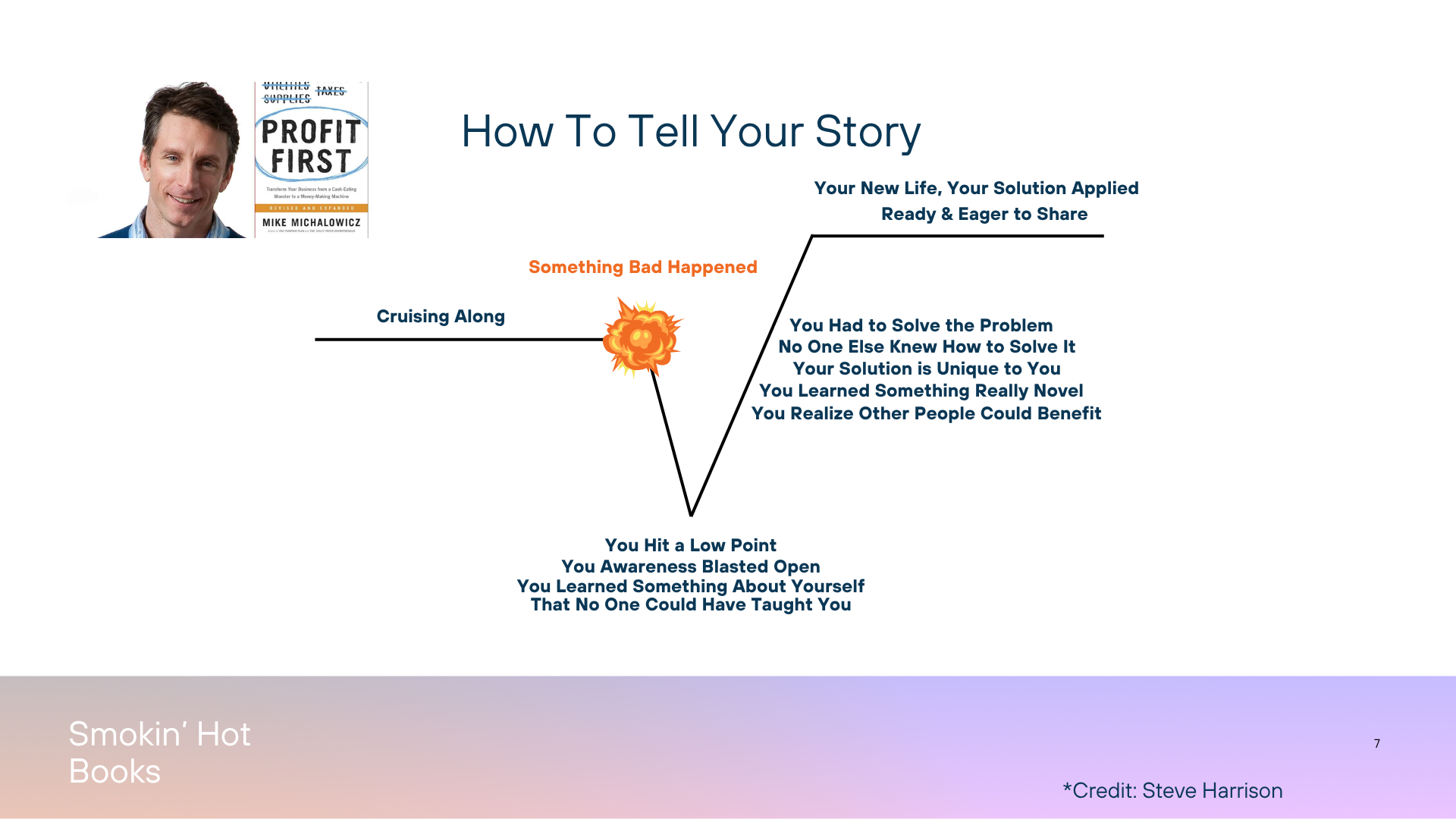
This storytelling framework is a personal branding device designed to keep you on track, relevant, and entertaining, which ultimately helps you build the connection so that sales are easier. Credit: Steve Harrison
All author clients at SHB are coached using this framework.
It clarifies your life in a way so that you connect the key events that are RELEVANT to your book and business.
Pay attention to the final stage: Your New Life, Your Solution Applied. Ready & Eager to Share.
It’s the easiest piece to figure out.
Because that’s you right now.
Your entire business is centered on the transformed version of you that you can’t help but sharing with the world.
That’s the key piece your ideal reader wants to know from you.
Take out your journal and answer this: when did you finally realize your message was something you had to take to the masses?
What lesson did you finally embody?
The beautiful thing here is that this is the same lesson your reader wishes to embody too.
This is the where your story and your ideal customer’s story start colliding.
3. Now go back through your memory and dig out how you lived this transformation the hard way.
There’s 5 elements of the How to Tell Your Story Framework:
Cruising Along
Something(s) Bad Happened
Rock Bottom
You Had to Solve the Problem
Your New Life, Your Solution Applied, Ready & Eager to Share
Notice that there’s 1 single throughline in this framework.
we want to hear your story and how you got here.

You lived a life of inner transformation. Now you guide others through that transformation too.
One of my favorite Youtube channels is about a Hasidic woman giving tours in Brooklyn. She made dozens of videos about Hasidic life, but after seeing dozens of these, what the Youtube comments really wanted was to know 1 thing: her story.
Out of everything that's ever happened to you, you have 1 main story that is the backbone of your personal brand as you write your book and promote it on podcast tour— the one that ends with your transformation (the final stage).
We don’t care to hear the parts of you that feel the most comfortable for you to tell or that make you sound the most impressive.
We want to hear the hurt.
We want to hear the hard parts that make you sad and wish it had been different.
Because the Ultimate Truth is that we are all experiencing the same brokenness in different ways, and that redeeming Love is relentlessly available.
One of my favorite examples of how this is demonstrated is Anne Beiler’s story on Cathy Heller’s podcast.
You can listen to it here.
For many of us, getting to a point where we can talk about the “rock bottom” moment takes practice, time, and self-love.

Sharing your truth requires courage, trust, patience, practice, and self-love. You may not be ready to tell that story now, but you are ready to start loving yourself, faults and all.
That’s why it’s called Marketing Alchemy: because the part of your story that you were afraid or ashamed to tell is actually just as relatable, just as lovable, just as golden as the rest of you.
Here is my own personal example.
Loving your shame and fear and self-doubt is an alchemical process.
It is when the disparate parts come together to be greater than the sum of its parts.
(The opposite is a mechanistic process, where you seek to understand the world by breaking it down further.)
Alchemy is the key to using your story to transform the world.
It’s also a key element of known personal branding strategy:
The more you accept your humanness, your more magnetic you are.
The more magnetic you are, the easier it is to market your business.
4. Now you’re ready to write your book.
Notice how there were 3 steps of preparation before this one. Preparation will get you much further than if you hadn’t prepared.
(I didn’t meal prep one week and ended up eating random junk for lunches. When I do meal prep, I make healthier, more economical food, for the whole week that sticks to my goals. Preparation helps you achieve your goals. Achieving your goals is what you want, isn’t it?)
Now you can write your book outline in a way that you know your reader will respond to it, they’re transformed by it, and it tells your story.
It will connect your reader with you.
Ultimately creating an environment for connection, belief-shifting, and ultimately, buy-in.
5. test everything before finalizing.
Dave Chilton sent each chapter to beta readers before finalizing The Wealthy Barber (2 million copies sold in Canada).
My client Amy sent her book to beta readers before finalizing (she’s closing in on 10,000 copies sold).
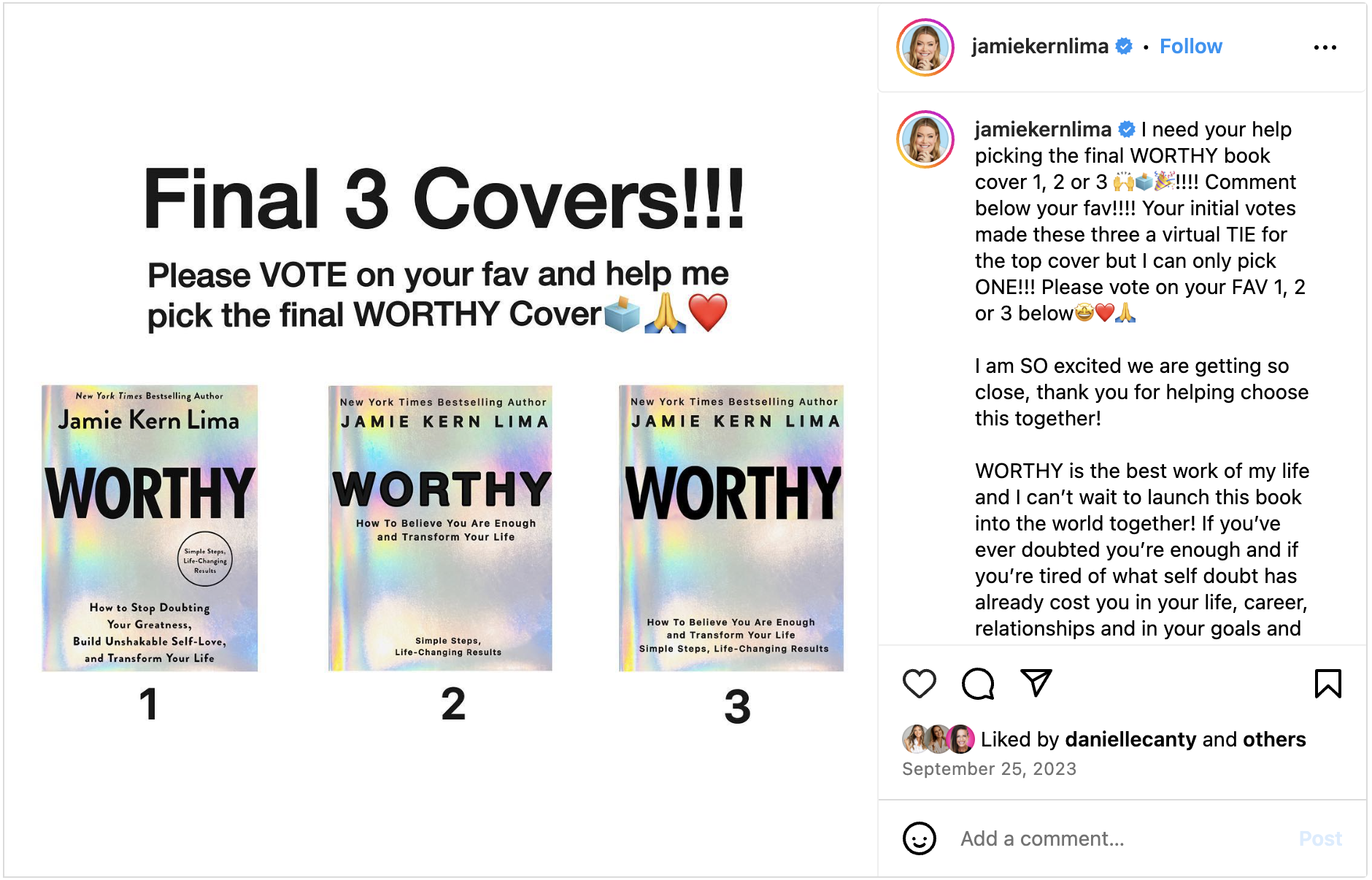
An example of author Jamie Kern Lima (credit: @jamiekernlima on Instagram) testing her covers with her target audience before finalizing.
My client Peter tested his book title and cover before finalizing.
Because they all know this 1 thing:
Marketing is not the last step you take.
It’s not something you bolt onto the end of a finished book.
The market is the first step, the first consideration, the people who will determine if your book will be a success.
Marketing is woven into the writing, the editing, the title, the cover…
Titles are tested with your audience before they’re finalized.
Covers are tested with your audience before they’re finalized.
VIP clients will have this coordinated for you if you choose the fully done-for-you option.
Because once you have a book that sells itself…marketing it is just a matter of targeted traffic.
So, ultimately how do you tell your story while also meeting your ideal reader where she’s at?
Think of it like this:
You’re not pinning your story versus your reader.
They are not at odds.
Instead, your reader’s desired transformation is the story you get to offer her.
Your reader is the filter from which you gain clarity on how to tell your own story in a way that is helpful to both you and to your ideal reader.
A true win-win.
Ready to write?
Let’s get to work. ❤️🔥
Renee